
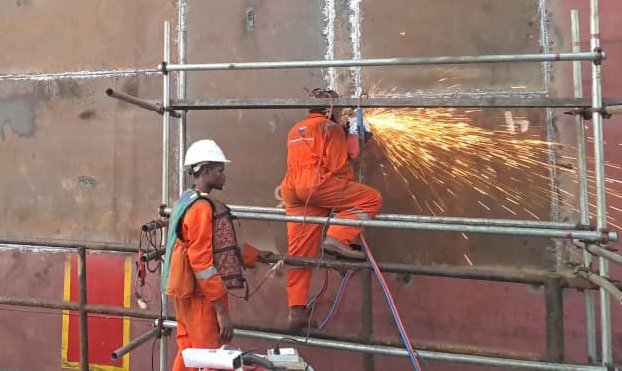
Welding and Fabrication Excellence for Oil & Gas and Marine Operations: A Technical Resource Guide
Welding and fabrication sit at the structural heart of every oil and gas facility and marine asset — from topside piperacks and pressure vessels to hull sections, subsea structures, and offshore jackets. In environments where a single weld defect can mean a pipeline shutdown, a stability failure, or a safety incident, the margin for error is effectively zero. This resource outlines the codes, materials, processes, and quality assurance practices that define reliable fabrication for these two demanding sectors.
Why Oil & Gas and Marine Fabrication Are Different
Both industries share a common thread: assets operate in corrosive, high-pressure, or cyclically loaded environments, often for decades, with limited access for repair. But each brings its own constraints:
- Oil & gas fabrication must contend with sour service (H2S), high-pressure/high-temperature (HPHT) conditions, and strict traceability requirements across the full material and weld lifecycle.
- Marine and offshore fabrication must account for dynamic loading from wave and vessel motion, saltwater corrosion, fatigue from cyclic stress, and classification society oversight (ABS, DNV, Lloyd’s Register, BV).
A fabrication partner working across both needs dual fluency — in process piping and pressure equipment codes, and in structural/hull codes governed by class societies.
Core Welding Processes Used in the Field
Selecting the right process is a function of material, joint geometry, position, and service conditions:
- Shielded Metal Arc Welding (SMAW/Stick): Still widely used for field repairs, tie-ins, and site welding where portability and tolerance to wind or less-controlled environments matter.
- Gas Tungsten Arc Welding (GTAW/TIG): The standard for root passes on critical piping, especially in stainless, duplex, and high-alloy systems where weld purity and X-ray quality are non-negotiable.
- Flux-Cored Arc Welding (FCAW) and Gas Metal Arc Welding (GMAW): Favored for structural steel fabrication, hull plating, and high-deposition work where productivity matters without sacrificing mechanical properties.
- Submerged Arc Welding (SAW): Used extensively in shop fabrication of pressure vessels, storage tanks, and long structural seams where deep penetration and consistency are priorities.
- Orbital GTAW: Increasingly standard for high-purity or repetitive small-bore piping welds, reducing operator variability on critical process lines.
Materials Commonly Encountered
- Carbon and low-alloy steels (A106, A333, A516) for general process piping and structural work.
- Stainless steels (304/316L) for corrosion resistance in produced water and chemical injection systems.
- Duplex and super duplex stainless steels for sour service, seawater handling, and high-chloride environments — these require tight heat input control to preserve the ferrite-austenite phase balance.
- Clad and lined pipe for corrosive service where a corrosion-resistant alloy overlay is bonded to a carbon steel backer.
- Marine-grade structural steels (e.g., ABS Grade A/B/D/E, EH-series) selected for toughness at low service temperatures and fatigue resistance.
Each material family carries its own preheat, interpass temperature, and post-weld heat treatment (PWHT) requirements — deviations here are a leading cause of in-service cracking.
Codes and Standards That Govern the Work
A credible fabrication program is built around recognized codes rather than internal preference:
- ASME Section IX — welding and brazing procedure and performance qualification.
- ASME B31.3 — process piping.
- API 1104 — welding of pipelines and related facilities.
- API 650/620 — welded storage tanks.
- AWS D1.1 — structural steel welding.
- NORSOK M-101 / M-601 — Norwegian offshore structural and piping welding requirements, often referenced for North Sea-style specifications.
- DNV, ABS, Lloyd’s Register, and Bureau Veritas class rules — hull, structural, and marine piping fabrication.
A fabricator’s Welding Procedure Specifications (WPS) and supporting Procedure Qualification Records (PQR) should map directly to whichever of these codes governs the contract, with welder qualifications kept current and traceable to specific process, position, and material combinations.
Quality Assurance and Non-Destructive Testing (NDT)
Weld integrity is verified, not assumed. A layered inspection approach typically includes:
- Visual Testing (VT) at every stage — fit-up, root, and final.
- Radiographic Testing (RT) for volumetric inspection of butt welds, particularly on pressure piping and vessels.
- Ultrasonic Testing (UT), including Phased Array UT (PAUT) and Time-of-Flight Diffraction (TOFD), increasingly preferred over RT for site work due to speed and lack of radiation exclusion zones.
- Magnetic Particle Testing (MT) and Dye Penetrant Testing (PT) for surface and near-surface discontinuities, especially on structural fillet welds.
- Positive Material Identification (PMI) to confirm alloy composition matches specification before and after welding — critical in preventing carbon steel/stainless steel mix-ups in the field.
- Hardness testing post-PWHT, particularly for sour service welds where NACE MR0175/ISO 15156 limits apply.
Fabrication Workflow: From Design to Delivery
- Engineering review and material take-off, ensuring specified materials, wall thickness, and corrosion allowances are correctly translated into fabrication drawings.
- WPS/PQR selection or development, matched to the joint design and service conditions.
- Cutting, beveling, and fit-up, with dimensional and alignment checks against isometrics or structural drawings.
- Welding execution under controlled preheat/interpass conditions, with real-time documentation of heat input, consumables, and welder identification.
- In-process and final NDT, per the applicable acceptance criteria.
- PWHT where specified, with time-temperature charts retained as quality records.
- Hydrotesting or pneumatic testing for pressure-retaining fabrication, and dimensional/coating inspection for structural work.
- Documentation package assembly — material certs, WPS/PQR, NDT reports, and traceability records — handed over as a complete quality dossier.
Common Failure Modes and How Sound Fabrication Prevents Them
- Hydrogen-induced cracking: mitigated through correct preheat, low-hydrogen consumables, and controlled cooling rates.
- Sensitization in stainless steels: avoided through heat input control and, where needed, post-weld solution annealing.
- Fatigue cracking in marine structures: addressed through proper weld profile control, toe grinding where specified, and adherence to fatigue-critical joint categories in class rules.
- Sour service cracking (SSC/HIC): controlled through hardness limits, material selection per NACE MR0175, and verified PWHT.
- Lamellar tearing in thick-section structural steel: mitigated through joint design choices and through-thickness material testing where restraint is high.
What to Look for in a Fabrication Partner
For operators and EPC contractors evaluating a welding and fabrication provider for oil & gas or marine scopes, a few markers separate a capable shop from a merely willing one:
- Current welder qualifications mapped to the actual processes and materials being used, not just a general certification on file.
- A documented and auditable NDT program with qualified, code-certified inspectors (ASNT or equivalent).
- Demonstrated experience with the specific service condition — sour gas, cryogenic, seawater, or high-cycle fatigue — rather than generalized fabrication experience alone.
- Full material traceability from mill certificate through final weld record.
- Class society familiarity for any scope touching hull or marine structural work.
Closing Thoughts
Reliable welding and fabrication is less about any single technique and more about disciplined process control — the right procedure, on the right material, verified by the right inspection, with a complete paper trail behind it. For oil & gas and marine operations, where assets are expected to perform safely for decades under harsh conditions, that discipline is what separates fabrication that merely looks complete from fabrication that is fit for purpose.
Medaan Engineering Services provides welding, fabrication, and quality assurance services across oil & gas and marine scopes. For project-specific technical discussions, reach out to our engineering team.