
The Complete Guide to Solar Panel Installation Cost & Process in Abuja (2026)
If you live or run a business in Abuja, you already know the problem: grid power is unreliable, generator fuel costs keep climbing, and noise and maintenance eat into your time and money. Solar has become less of a luxury upgrade and more of a practical necessity for homes, offices, and industrial sites across the FCT.
But solar is also an area where a lot of misinformation circulates — vague quotes, mismatched components, and installers who cut corners on wiring or battery quality. This guide walks you through exactly how to think about sizing, cost, and the installation process, so you can make an informed decision whether you’re powering a small apartment or a commercial facility.
1. How to Size a Solar System for Your Home or Business
Before any cost conversation makes sense, you need to know your load — how much power you actually use.
Step 1: List your appliances and their wattage Add up the running wattage of everything you want to power: fridge, freezer, TVs, fans, air conditioners, pumping systems, office equipment, etc. Don’t forget “starting wattage” for appliances with motors (fridges, AC units, pumps) — these draw more power for a second or two when they switch on.
Step 2: Calculate your daily energy consumption (kWh) Multiply each appliance’s wattage by the hours you use it per day, then add it all up. This gives you your daily kilowatt-hour (kWh) requirement — the single most important number for sizing your system.
Step 3: Match this to inverter size and battery capacity
- Inverter size (kVA) is based on the total load you’ll run at the same time — this determines whether you need a 2kVA, 5kVA, 10kVA system or larger.
- Battery capacity (kWh or Ah) is based on how many hours you need power without sunlight (overnight, cloudy days) — this is where most underpowered systems fail. Undersized batteries are the #1 reason people complain that “solar doesn’t work” in Nigeria.
- Panel capacity (kW) is sized to fully recharge your batteries within a normal sunlight day (typically 5–6 peak sun hours in Abuja) while also carrying your daytime load.
A rough example: a household running two fridges, fans, TVs, lighting, and occasional AC use for a few hours typically needs somewhere in the 5kVA–10kVA range with matching battery capacity. Every home is different — this is why a proper site and load assessment matters more than picking a “package” off a price list.
2. Off-Grid vs Hybrid vs Grid-Tied: Which Fits Abuja?
| System Type | How It Works | Best For |
| Off-grid | Fully independent of the national grid; solar + batteries only | Areas with poor/no grid access, or anyone wanting complete independence |
| Hybrid | Combines solar, battery storage, and grid/generator input; automatically switches sources | Most Abuja homes and businesses — balances cost with reliability |
| Grid-tied | Solar feeds into the grid, no batteries; only works when grid is live | Rare fit for Nigeria given grid instability; not recommended without storage |
For most homes and SMEs in Abuja, a hybrid system offers the best balance — it uses solar as the primary source, falls back on stored battery power when the sun isn’t out, and can still draw from the grid or a generator as a last resort. This avoids the “all or nothing” risk of a pure off-grid system while cutting fuel and grid dependence significantly.
3. Realistic Cost Ranges by System Size
Solar pricing in Nigeria depends on panel brand, battery chemistry (lithium vs lead-acid), inverter quality, and installation complexity. The ranges below are general market guidance, not a quote — always get a proper site assessment before budgeting precisely, as import costs and forex rates also shift pricing over time.
| System Size | Typical Use Case | Approximate Price Range (Naira) |
| 2kVA – 3kVA | Small apartment, few essentials (lights, fans, TV, fridge) | Entry-level residential range |
| 5kVA | Family home with moderate appliance use, some AC | Mid-range residential |
| 10kVA | Larger home or small office with heavier daytime load | Upper residential / small commercial |
| 15kVA+ | Commercial premises, small industrial use | Commercial-grade, custom-quoted |
Two components typically drive most of the cost difference between quotes:
- Battery type — lithium (LiFePO4) batteries cost more upfront but last significantly longer (often 8–10+ years) and handle deeper discharge cycles better than lead-acid batteries, which are cheaper initially but need replacing more often.
- Panel and inverter brand — Tier-1 panel brands and reputable inverter manufacturers cost more than unbranded imports but come with real warranties and better long-term performance.
A word of caution: the cheapest quote is rarely the best value. Underspecified batteries, unbranded inverters, and poor installation are the most common reasons solar systems in Nigeria underperform or fail early.
4. Panel & Battery Technology: What You’re Actually Buying
Solar Panels
- Monocrystalline panels — higher efficiency, better performance in limited roof space, generally longer lifespan. Usually the better choice where roof/ground space is constrained.
- Polycrystalline panels — slightly lower efficiency but more budget-friendly where space isn’t a constraint.
Batteries
- Lithium (LiFePO4) — longer lifespan, faster charging, deeper safe discharge, lighter weight, better for daily heavy-cycle use. Higher upfront cost.
- Lead-acid (including deep-cycle/gel) — lower upfront cost, but shorter lifespan and lower usable capacity (typically only 50% of rated capacity should be discharged, versus 80–90% for lithium).
For most serious installations today, lithium batteries generally offer better long-term value despite the higher initial cost, due to lifespan and lower total cost of ownership over time.
5. The Installation Process, Step by Step
- Site Assessment & Load Audit — An engineer visits your property to assess roof/ground space, sun exposure, shading, and your actual appliance load.
- System Design — Based on the assessment, we design a system specifying panel count and placement, inverter size, and battery bank capacity.
- Proposal & Component Sourcing — You receive a clear breakdown of components, brands, and cost before any commitment. Components are sourced or confirmed in stock.
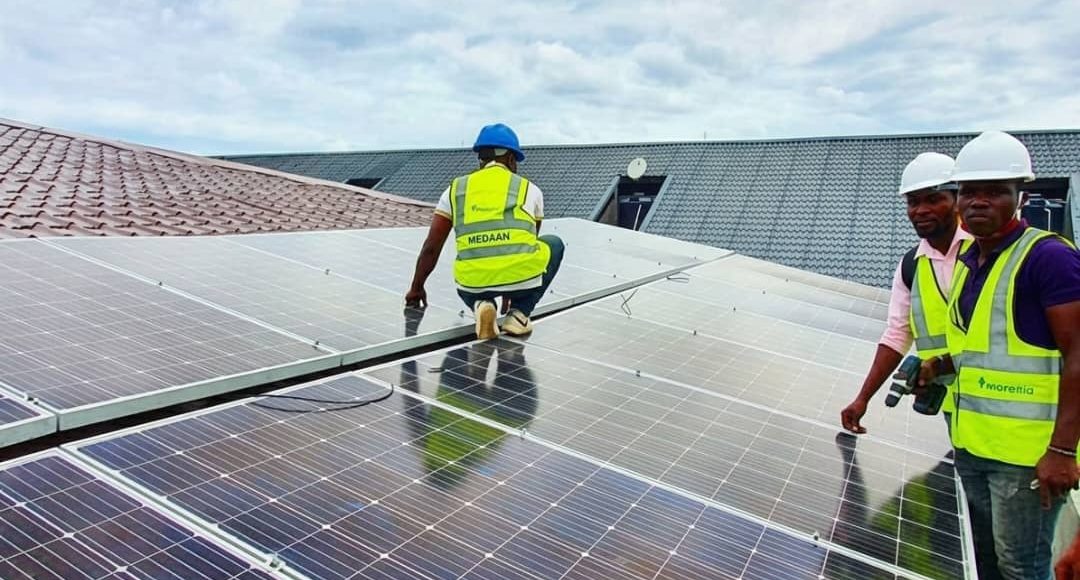
- Mounting & Electrical Installation — Panels are mounted (roof or ground-mount), wiring is run to the inverter and battery bank, and all connections are properly earthed for safety.
- Inverter & Battery Configuration — The inverter is configured to prioritize solar, manage battery charge/discharge cycles, and set safe switch-over thresholds between solar, battery, and grid/generator.
- Testing & Commissioning — The full system is tested under real load conditions to confirm performance matches the design before handover.
- Client Handover & Training — You’re walked through how to monitor and use the system, including any mobile monitoring app if applicable.
A properly managed installation typically takes anywhere from a few days (small residential) to a few weeks (larger commercial systems), depending on system size and site conditions.
6. Maintenance and Expected Lifespan
Solar systems are low-maintenance but not zero-maintenance:
- Panels should be cleaned periodically (dust and harmattan haze reduce output) and typically last 20–25 years with minimal degradation.
- Batteries need periodic inspection; lithium batteries generally require less intervention than lead-acid, which may need water top-ups (for flooded types) and more frequent capacity checks.
- Inverters should have firmware/settings reviewed occasionally and are typically the first component to need replacement, often after 8–12 years depending on usage and quality.
Scheduling an annual system check is the easiest way to catch small issues (loose connections, panel soiling, battery capacity drop) before they become costly failures.
7. Common Mistakes to Avoid When Hiring a Solar Installer in Nigeria
- Accepting a quote without a load assessment — if a company gives you a system size and price without discussing your actual appliance load, that’s a red flag.
- Undersized batteries — the most common cause of disappointing solar performance; make sure battery capacity matches your real overnight/no-sun usage, not just daytime load.
- No warranty or documentation — reputable installers provide warranty terms on panels, batteries, and inverters, plus a clear system specification document.
- Ignoring installer experience with your property type — commercial and industrial installations have different safety and load requirements than residential ones; ask about relevant project experience.
- Choosing solely on price — the cheapest system is often the most expensive one over 5 years once battery replacement and poor performance are factored in.
Frequently Asked Questions
How much does solar installation cost in Abuja? Cost depends heavily on system size and component quality, ranging from entry-level residential systems to larger custom commercial installations. A site assessment is the only reliable way to get an accurate figure for your specific needs.
How long does solar panel installation take? Small residential systems can often be completed within a few days; larger commercial systems may take a few weeks depending on complexity.
Do I need batteries with solar panels in Nigeria? Given the instability of the national grid, yes — a battery-backed hybrid system is almost always the right choice for reliable power in Abuja, rather than a grid-tied system with no storage.
How long do solar batteries last? Lithium batteries typically last significantly longer than lead-acid batteries under regular use, though actual lifespan depends on usage patterns, depth of discharge, and maintenance.
Can solar power an entire office or commercial building? Yes, with correct sizing. Commercial installations require a more detailed load audit and often a larger, custom-engineered system, but there’s no technical reason solar can’t power an entire commercial facility.
Ready to Go Solar?
Every property is different, and the numbers above are a starting point — not a substitute for a proper site visit. Medaan Engineering Services designs, installs, and maintains solar energy systems for residential, commercial, and industrial clients across Abuja and the FCT.
Contact us today for a free load assessment and a system designed around your actual power needs.
G.O.P Mall
Plot 6, Karu Layout
Nyanyan- Jikwoyi Road
Karu, Abuja
08067026831
Medaan Engineering Services Limited — Hydraulics & Marine Services | Renewable Energy & Solar Solutions | ICT & Systems Integration