- November 10, 2025
- 329 Views
- 4 Likes
- ICT, RENEWABLE ENERGY
Artificial Intelligence and Renewable Energy Optimization in Nigeria
The Smart Power Revolution
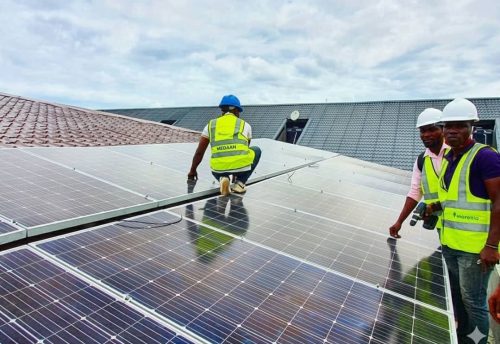
Nigeria’s energy landscape is changing fast. As the country struggles to bridge its long-standing power deficit, renewable energy—particularly solar and wind—has become the bright hope for the future. Yet, integrating these sources efficiently into the grid presents a new challenge.
Enter Artificial Intelligence (AI) — the game-changer poised to transform how Nigeria produces, manages, and consumes renewable energy. AI is not just about robots and automation; it’s about data, prediction, and smart decision-making — exactly what Nigeria’s power sector needs.
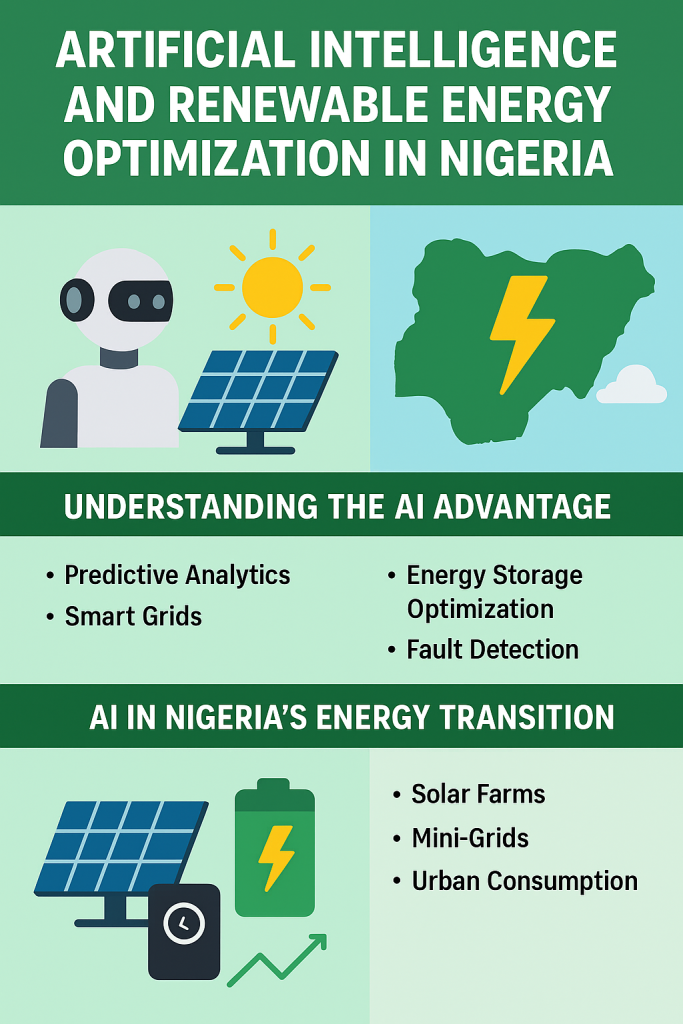
Understanding the AI Advantage
Renewable energy is inherently variable — the sun doesn’t always shine, and the wind doesn’t always blow. This unpredictability creates instability in energy systems that rely on renewables. AI steps in to solve this problem through data-driven optimization:
Predictive Analytics: AI can forecast solar radiation and wind speeds, helping operators plan power output in advance.
Smart Grids: AI-driven grids balance supply and demand in real-time, reducing blackouts.
Energy Storage Optimization: Algorithms decide when to store excess power and when to release it for use.
Fault Detection: AI identifies system failures or inefficiencies before they cause downtime.
In short, AI makes renewable energy systems intelligent, efficient, and reliable.
AI in Nigeria’s Energy Transition
Nigeria’s journey toward renewable energy is guided by its Energy Transition Plan (ETP), which aims for net-zero emissions by 2060. But to make this dream achievable, efficiency is key. That’s where AI fits in:
Solar Farms: AI can monitor thousands of panels, adjusting orientation and performance automatically.
Mini-Grids: Intelligent systems can allocate power among villages based on usage patterns and battery levels.
Urban Consumption: Smart meters and AI-based billing can reduce energy theft and improve cost recovery for utilities.
AI doesn’t just make renewables smarter — it makes the entire system more sustainable and economically viable.
Challenges to Overcome
While the benefits are clear, Nigeria faces several barriers to full-scale AI adoption in energy:
Data Scarcity: Limited data from power infrastructure slows AI development.
High Costs: AI systems require investment in sensors, analytics software, and skilled personnel.
Lack of Policy Framework: Regulations around AI in energy are still emerging.
Capacity Gap: There’s a shortage of local expertise in AI modeling and renewable energy integration.
Overcoming these will require strong partnerships between government, academia, and private innovators.
Innovation on the Horizon
Despite the challenges, progress is underway. Nigerian startups are developing AI-powered solar management tools and smart monitoring systems. Global collaborations are also helping train local engineers in energy analytics and automation.
Imagine a Nigeria where solar farms self-optimize, mini-grids predict community needs, and the national grid adjusts itself automatically — a digital-first energy ecosystem built for resilience and sustainability.
Final Word
Artificial Intelligence is not the future — it’s the missing link in Nigeria’s renewable energy revolution. By combining data, automation, and clean power, AI offers a pathway to stable, affordable, and intelligent energy for all.
If Nigeria embraces AI-driven optimization today, it can leapfrog into a future where power outages are history, and every watt counts toward progress.