- September 23, 2025
- 355 Views
- 2 Likes
- ICT, RENEWABLE ENERGY
Digital Tools, Smart Grids, and Nigeria’s Path to Energy Efficiency
Digital Tools, Smart Grids, and Nigeria’s Path to Energy Efficiency
Powering the Future
Nigeria’s electricity story is one of contrast. On one hand, the nation is rich in natural resources and has Africa’s largest economy. On the other, millions of Nigerians still live without reliable power, and businesses lose billions each year to blackouts and generator fuel costs.
But a quiet revolution is underway. Beyond solar panels on rooftops and wind turbines on farmlands, a new ingredient is being added to Nigeria’s energy mix: digital technology. With smart meters, mobile apps, and intelligent power grids, the country is slowly finding its way toward a more efficient and reliable energy future.
Why Digital Matters
Electricity in Nigeria has long been inefficient. Power theft, poor billing, and outdated infrastructure mean that nearly 40% of generated electricity never reaches paying customers. Digital tools can flip this story around:
- Smart Meters: No more “estimated bills.” Households pay for exactly what they use.
- Mobile Payments: Imagine topping up your electricity like airtime—already happening in solar-powered mini-grids across rural communities.
- IoT & AI: Tiny sensors and smart software can predict faults before they cause blackouts.
- Energy Dashboards: Businesses can track every kilowatt consumed, cutting waste and costs.
In short, digitalization brings transparency, trust, and control—three things Nigeria’s power sector has been missing for decades.
What’s a Smart Grid, Anyway?
Think of the old power grid as a one-way street: electricity flows from power plants to your home, and that’s it. A smart grid, on the other hand, is like a two-way expressway, full of traffic signals and roundabouts. Power doesn’t just flow—it’s monitored, redirected, and optimized in real time.
For Nigeria, this could mean:
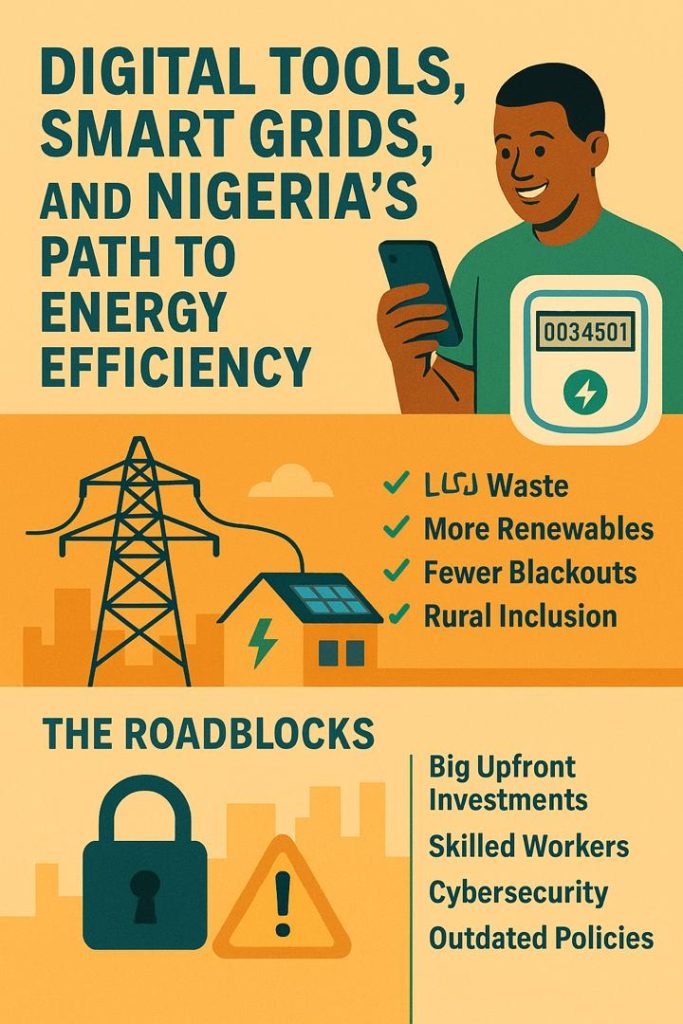
✅ Less Waste: Electricity theft becomes easier to detect.
✅ More Renewables: Solar and wind can be blended smoothly with traditional sources.
✅ Fewer Blackouts: Faults can be spotted and fixed faster.
✅ Rural Inclusion: Smart microgrids can bring power to villages and later connect to the national grid.
It’s the kind of backbone Nigeria needs if it hopes to meet its 2060 clean energy goals.
The Roadblocks
Of course, the shift won’t be easy. Smart grids and digital systems require big upfront investments, skilled workers to run them, and strong cybersecurity to keep hackers out. Policies also need to catch up with technology, or progress will stall.
Bright Spots on the Horizon
Despite the challenges, the opportunities are enormous:
- Startups are already using pay-as-you-go solar models to light up rural homes.
- Public-Private Partnerships are slowly channeling funds into digital energy projects.
- Young Innovators are building apps and IoT devices that make energy smarter and cheaper.
Nigeria may be behind on the power curve, but with digital tools and smart grids, it has the chance to leapfrog into the future, skipping the old mistakes made elsewhere
Final Word
The future of electricity in Nigeria won’t just be about wires, transformers, and solar panels—it will be about data, connectivity, and smart decisions. Digital tools and smart grids can transform an inefficient system into one that’s responsive, reliable, and ready for the challenges of tomorrow.
The question now is simple: Will Nigeria invest in the intelligence needed to power its future?