- September 26, 2025
- 262 Views
- 3 Likes
- ICT, RENEWABLE ENERGY
How Renewable Energy Can Revolutionize Nigeria’s Agricultural Value Chain
Powering the Fields
Agriculture remains the backbone of Nigeria’s economy, employing more than 35% of the workforce and feeding over 200 million people. Yet, the sector struggles with outdated methods, post-harvest losses, and high production costs. One major culprit? Unreliable energy.
From irrigation pumps that sit idle to crops that rot in storage, lack of consistent power stifles productivity and profits. But with the rise of renewable energy technologies, a new era of farming is within reach—one where Nigeria can move from subsistence to sustainable agribusiness.
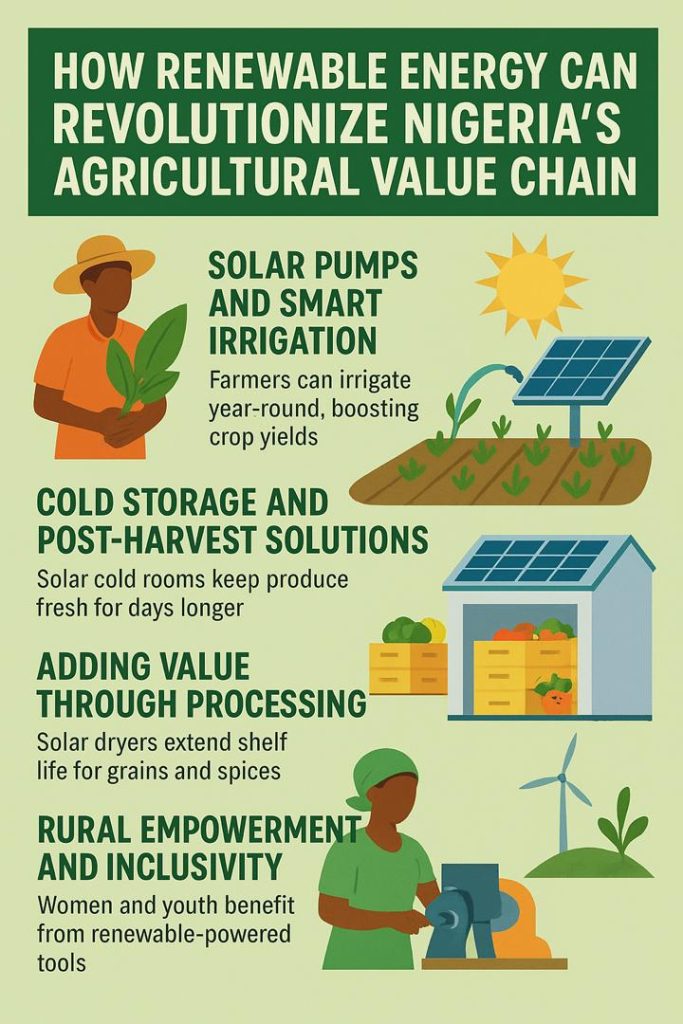
Solar Pumps and Smart Irrigation
Water is life for crops, yet many Nigerian farmers rely on rainfall, leaving them vulnerable to climate change. Enter solar-powered irrigation systems:
- Farmers can irrigate year-round, boosting crop yields.
- Off-grid communities gain independence from diesel pumps and costly fuel.
- Smart irrigation tools linked to mobile apps help farmers conserve water and maximize efficiency.
In dry regions like the North, solar irrigation could be the game-changer that transforms agriculture into a reliable source of income and food security.
Cold Storage and Post-Harvest Solutions
Nigeria loses up to 40% of its harvest before it reaches markets—mostly because of poor storage and transport conditions. Renewable energy offers practical fixes:
- Solar cold rooms keep fruits, vegetables, and dairy products fresh for days longer.
- Mini-grids in rural hubs can power small-scale food processing like rice milling, tomato drying, or cassava grinding.
- Biogas plants convert waste from farms into electricity, reducing spoilage while generating extra income.
With these tools, farmers don’t just grow more—they sell more, waste less, and earn better.
Adding Value Through Processing
Agriculture in Nigeria is often stuck at the raw commodity stage. Cocoa is exported unprocessed, cassava is sold without packaging, and tomatoes spoil before processing. Renewable energy can unlock value addition:
- Solar dryers extend shelf life for grains, fruits, and spices.
- Wind and mini-hydro power can drive small agro-processing factories.
- Clean, stable power encourages private investors to set up rural industries, creating jobs and reducing imports.
When farmers can process, package, and store their products locally, the value chain strengthens, and profits remain within communities.
Rural Empowerment and Inclusivity
Renewable energy doesn’t just power machines—it powers people. Women and youth, who form a large portion of Nigeria’s smallholder farmers, benefit most when renewable-powered tools reduce labor and create new business opportunities. From solar-powered grinding machines to energy-backed agritech startups, the shift means more inclusion and less drudgery.
Challenges to Overcome
Of course, the road is not without bumps:
- High upfront costs for solar and renewable systems.
- Financing gaps, as smallholder farmers often lack access to loans.
- Policy inconsistencies that slow private sector investment.
- Technical capacity gaps in maintaining and scaling renewable systems.
But with government incentives, micro-financing models, and public-private partnerships, these challenges can be turned into opportunities.
Final Word
Renewable energy is more than a climate-friendly option—it’s a strategic enabler for Nigeria’s agricultural transformation. By powering irrigation, storage, processing, and distribution, renewables can unlock higher yields, cut losses, and put more money into farmers’ pockets.
If Nigeria embraces this shift, agriculture will not only feed the nation but also drive exports, create rural jobs, and strengthen food security. In short, renewable energy could turn Nigeria’s farms into engines of economic revolution